Building autcode.com: How We Launched a Software House Website with Kreatywna Agencja
A software house website has one job that most websites don’t: convince technical people that you are technical. Our buyers are CTOs, founders and project managers at agencies. They read source code for fun, they notice a slow page in under a second, and they have heard every “innovative, cutting-edge solution” pitch already. This is the story of how we built autcode.com, a software house website for the B2B agency market, together with Kreatywna Agencja.
If you are planning a similar project, this article covers the brief, the process, what we shipped, and what we would do again. We have kept it concrete. Where we have no hard number, we say so.
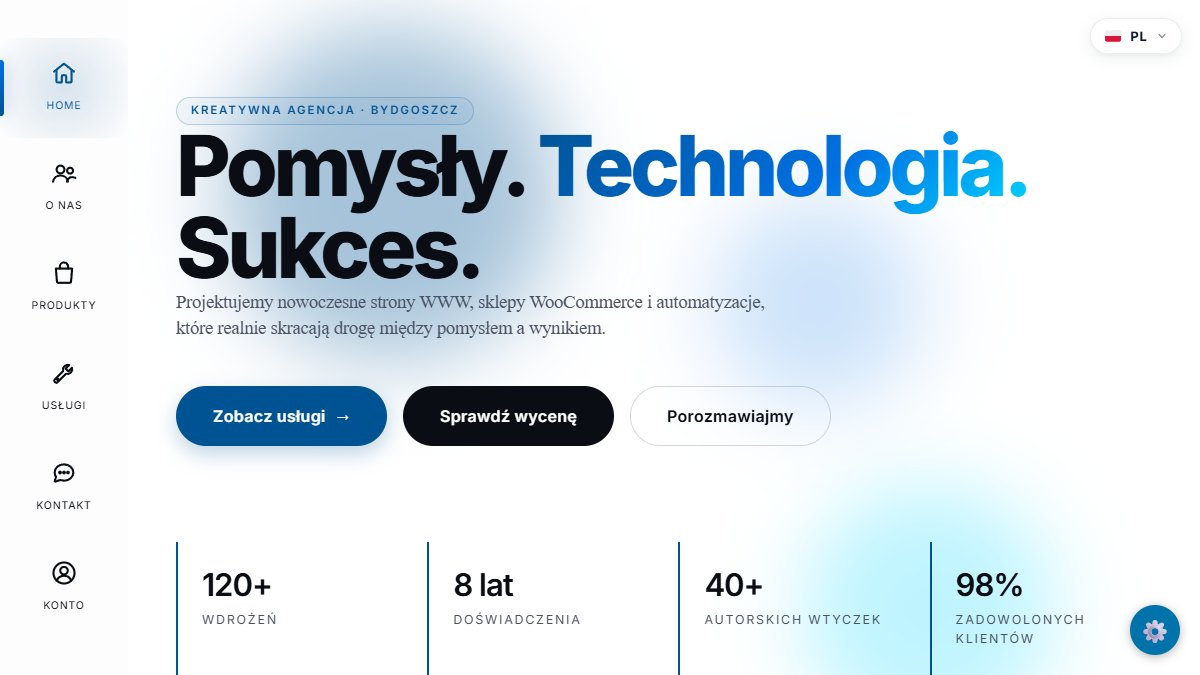
The challenge: a website that talks to agencies, not end customers
AutCode builds custom WooCommerce development, AI-powered WordPress tools, n8n workflow automation and system integrations. Most of our work is white-label: we deliver for agencies who put their own brand on top. That shapes everything about the website.
A typical agency site speaks to a business owner who wants “more sales”. Ours had to speak to a project manager who needs a reliable subcontractor, a CTO who wants to see how we think, and a founder who wants to know what it will cost before booking a call. The requirements we wrote down were:
- A clear message. One sentence on the homepage that says who we serve and what we build.
- Four service areas with real scope and “starting at” prices, not vague capability lists.
- A product portfolio. We maintain 20+ plugins, and visitors should be able to browse them like a catalogue.
- A project cost calculator so a buyer can estimate a budget without talking to sales.
- Free audit tools that prove our competence by doing real work for the visitor.
- A modular admin panel. We knew we would keep adding tools, and we did not want a pile of unrelated plugins to maintain.
The last point was the hardest. We needed a partner who understood three things at once: how a software house operates, how WordPress really works under the hood, and how to build for modularity instead of for launch day only.
Why we chose Kreatywna Agencja
We looked at design studios and at pure development shops. Neither fit. Kreatywna Agencja did, for four reasons.
- WordPress and custom plugins. They build their own plugins and portals rather than assembling themes from page builders. That matters when your site is also a product platform.
- Experience with agency and software house clients. They understood white-label, subcontracting and the B2B buying cycle without a long briefing.
- Modular thinking. Their approach to scaling a codebase, where each feature is an isolated module with its own settings and lifecycle, matched what we needed.
- A compatible tech stack. PHP, n8n automations and AI integrations are everyday tools for them, so we did not have to explain what a webhook or an LLM call is.
Process and collaboration
We worked in short, sprint-based cycles with a weekly demo. Every Friday we saw working software on a staging environment, not slides.
1. Audience analysis
We started with three personas: the project manager comparing subcontractors, the CTO checking technical depth, and the founder checking price and risk. Every page had to answer at least one persona’s main question.
2. Architecture
The information architecture is deliberately flat: Home, Services, Products, Pricing, Work, About, Blog, and a group of free tools. A visitor is never more than two clicks from a price or a proof point.
3. Design and UX
We chose a technical look with a purple brand colour, modular components that repeat across pages, and a mobile-first layout. Agencies browse on phones between meetings, and then forward the link to a colleague.
4. Development
This is where custom WordPress development paid off. We split the build into a custom theme for presentation and a single modular plugin, “Autcode System”, for everything else.
5. Testing
We used Playwright for browser-level checks, plus reviews for security, GDPR (RODO) consent behaviour and WCAG accessibility. Tests run against the real pages after deployment, because a syntax error in a bootstrap file can take a WordPress site down, and we wanted to catch that in minutes.
Two habits kept the project honest. First, every sprint ended with a demo on staging, so feedback arrived while changes were still cheap. Second, we agreed on a definition of done up front: a feature is finished only when it is documented, tested in the browser, accessible by keyboard and deployed. That discipline is easy to promise and hard to keep, and it is the main reason the launch was calm instead of a scramble. Decisions were logged in writing, scope changes were priced before they were built, and nobody had to guess what the next demo would show.
The solution delivered
Platform features
- Four service areas with scope, deliverables and starting prices.
- Product showcase for 20+ plugins, each with its own page and purchase flow through WooCommerce.
- Interactive pricing calculator that turns a few choices into a budget range.
- Free audit tools for SEO, accessibility (WCAG), GDPR, WordPress security and AI readiness. The visitor enters a URL and gets a real report.
- User accounts and a dashboard where clients can see their audits and orders.
Backend and architecture
The core of the platform is a modular WordPress plugin. Each capability, for example the SEO audit, the GDPR check, the blog generator or the client brief, is a self-contained module with its own code, settings and tests. All modules are managed from one admin panel and one settings system.
On top of that sit a custom WordPress theme, an OpenAI integration for AI-generated analysis and summaries, n8n workflows for automation and approvals, and a scripted FTPS deploy that uploads the theme and plugins in a single command.
Design and experience
The interface is technical and calm: purple branding, strong typographic hierarchy and little decoration. We aimed for WCAG 2.1 AA accessibility, built in a cookie and GDPR consent layer, and kept Core Web Vitals in mind from the first template: local fonts, lazy-loaded images and no heavy page builder.
Scalability
Adding a new tool now means adding a new module. It appears in the same panel, uses the same settings API and follows the same conventions. There is no new vendor plugin to evaluate, no conflicting admin screens and no mystery updates. That is the difference between a B2B agency platform and a website with plugins stacked on top.
Results and impact
We want to be careful here. The site is young, and we would rather describe what changed than quote numbers we cannot back up.
Business impact
- Clearer communication. Visitors can tell within seconds that we build for agencies, and which of four services applies to them.
- Self-serve pricing. The calculator and “starting at” prices mean the first conversation is about scope, not about whether we are affordable.
- A lead engine that does not feel like one. The free audits give a visitor something useful first. The report, not a form, starts the relationship.
- A system we can extend. New tools ship in days because the framework already exists.
Technical impact
- SEO: clean semantic markup, schema.org data on the tool pages, and fast server-rendered templates.
- Accessibility: keyboard navigation, contrast and ARIA labels reviewed against WCAG 2.1 AA.
- GDPR: consent management that blocks non-essential scripts until the visitor agrees.
- Performance: lightweight theme, local fonts and cache-friendly assets.
Key learnings
- B2B buyers look for proof, not slogans. A working audit tool convinced more people than any paragraph about quality.
- Modularity is an investment that pays back. It costs more in the first sprint and saves time in every sprint after.
- Free tools can generate leads if they deliver real value before asking for contact details.
- Transparent pricing attracts better leads. People who see a price and still get in touch are already qualified.
- WordPress plus a custom plugin beats an off-the-shelf SaaS when you need to own the data, the logic and the roadmap. This is where the team’s WordPress expertise made the difference.
Technologies used
- WordPress and WooCommerce for content, products, accounts and checkout.
- Custom PHP plugin (modular) for audit tools, AI features and the admin panel.
- Custom theme with reusable components and local assets.
- OpenAI API for report analysis and content generation.
- n8n for automation, notifications and approval flows.
- Playwright for end-to-end browser tests.
- FTPS deployment script for repeatable releases.
Partnership wrap-up
Working with Kreatywna Agencja felt like working with an extension of our own engineering team. They were professional, they knew WordPress at the code level, and communication was direct: short questions, quick answers, no account-manager layer. They thought in modules from day one, and they stayed available after launch for fixes and improvements. Would we recommend them? Yes, without hesitation.
Need a software house website that converts?
If you are a software house or tech agency and need a professional website that converts, check out Kreatywna Agencja. You can also browse their case studies to see how they approach other projects.
And if you want to see what our platform does, try one of our free tools: the SEO audit, the accessibility check or the GDPR check. Prefer to talk? See our services, pricing or get in touch.
Website by Kreatywna Agencja.