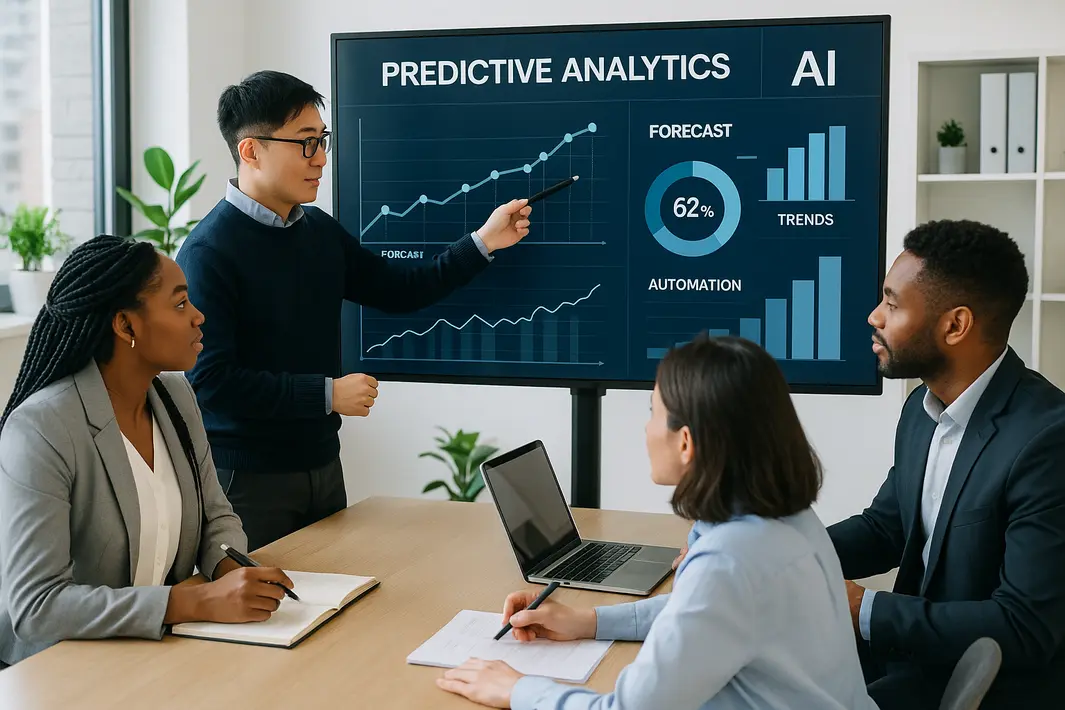
Leveraging Predictive Analytics with AI-Powered Automation for Proactive Business Strategies
In today’s rapidly evolving business landscape, organizations must stay ahead of uncertainty, adapt swiftly to market trends, and anticipate challenges before they arise. Traditional reactive strategies no longer suffice in the age of data-driven decision-making. Enter predictive analytics automation combined with AI-powered automation—a transformative approach that empowers businesses to convert raw data into actionable insights and take proactive steps rather than reactive ones. With technological advancements bringing AI workflow builders and AI tools for small business into the mainstream, organizations of all sizes can now harness the benefits of business workflow automation to strengthen their strategies and secure a lasting competitive edge.
The Synergy of Predictive Analytics and Automation
Understanding Predictive Analytics Automation
Predictive analytics automation involves the use of AI and machine learning algorithms to analyze historical and real-time data, predict future outcomes, and automate responses. The integration of these technologies streamlines decision-making and allows organizations to anticipate customer behaviors, market movements, and operational disruptions. Unlike manual data analysis, predictive analytics automation continuously processes vast amounts of information, identifying trends and anomalies with unparalleled accuracy and speed.
The Power of AI Automation for Business
When predictive analytics is embedded within AI automation for business, companies can do much more than forecast trends—they can initiate automated actions in response to those predictions. This might include adjusting inventory levels, launching targeted marketing campaigns, or reallocating resources based on demand projections. By leveraging AI-powered business workflow automation, businesses can ensure that insights gleaned from data translate seamlessly into action, reducing lag time and improving agility.
Benefits of Proactive Business Strategies Through AI
Anticipating Market Changes
At the core of proactive business strategies lies the ability to foresee market trends and consumer needs before they become apparent to the competition. AI tools for small business, as well as enterprise-level solutions, can analyze customer purchasing patterns, monitor competitors, and even predict shifts in supply chains. With predictive analytics automation, businesses can respond to opportunities and threats quickly, transforming insights into concrete actions that improve customer satisfaction and financial performance.
Enhancing Operational Efficiency
Business workflow automation powered by AI can identify inefficiencies within organizational processes—from procurement to customer service—and recommend or execute optimization strategies. For example, AI workflow builders can automate repetitive manual tasks, allocate resources more precisely, and anticipate maintenance needs for equipment. The result is a significant reduction in operational bottlenecks, minimized downtime, and better resource utilization, enabling teams to focus on strategic initiatives.
Key Components of AI Workflow Builders
Drag-and-Drop Interface and Integration
Modern AI workflow builders provide intuitive drag-and-drop interfaces that simplify the creation and customization of automated workflows. These platforms are designed with integration in mind, allowing seamless connections to data sources, applications, and communication channels such as email, CRM systems, and analytics dashboards. By enabling even non-technical users to design and deploy automation processes, AI workflow builders democratize automation across the organization, driving innovation from every department.
Real-Time Monitoring and Adaptation
A crucial element of AI automation for business lies in its adaptability. AI workflow builders continuously monitor process efficiency and outcomes, adjusting automation logic as new data comes in. For example, if a predictive model identifies an emerging trend in customer behavior, the workflow can automatically update outreach strategies or reallocate inventory accordingly. This dynamic adjustment ensures that business workflow automation evolves in tandem with changing business conditions.
AI Tools for Small Business: Leveling the Playing Field
Affordable and Scalable Solutions
Previously, cutting-edge automation and predictive analytics were reserved for large enterprises with deep pockets and technical expertise. However, the proliferation of AI tools for small business has changed the game entirely. Many platforms now offer affordable, subscription-based models that scale alongside business needs. This democratization of technology allows small and medium-sized businesses to benefit from AI workflow builders, streamlining operations and identifying growth opportunities without significant upfront investment.
Use Cases in Small Business Operations
Small businesses can deploy predictive analytics automation in various ways, such as forecasting product demand, identifying high-value leads, personalizing customer experiences, and automating financial tasks like invoicing or budgeting. These advantages do not just increase productivity and profitability; they secure a competitive position in markets traditionally dominated by larger players. By automating decision-making based on real-time data, even smaller entities can pivot quickly and address customer needs proactively.
Implementing Predictive Analytics Automation for Proactive Strategies
Steps for Successful Adoption
Integrating predictive analytics automation into the business workflow requires a structured approach. Key steps include:
- Data Assessment: Identify and collect relevant data from all departments, ensuring data quality and consistency.
- Platform Selection: Choose an AI workflow builder that aligns with specific business objectives and supports necessary integrations.
- Model Development: Collaborate with data experts to build, train, and validate predictive models that suit unique business needs.
- Workflow Design: Create automated workflows that trigger actions when predictive thresholds are met—such as restocking inventory, targeting at-risk customers, or sending alerts.
- Continuous Monitoring: Regularly assess model performance and workflow effectiveness, refining automation as requirements evolve.
Overcoming Common Challenges
While the benefits of AI automation for business are substantial, some challenges may arise during implementation. These include data silos, resistance to change among staff, and the need for ongoing model retraining. Overcoming these hurdles involves fostering a data-driven culture, providing adequate training, and selecting AI tools for small business that emphasize user-friendliness and transparency. By committing to continuous improvement, organizations can maximize the ROI of predictive analytics automation and develop truly proactive business strategies.
The Future of Proactive Business Strategies with AI
Emerging Trends and Opportunities
Looking forward, the convergence of AI, automation, and predictive analytics promises even more sophisticated approaches to strategic planning. Advanced algorithms, greater processing power, and expanded data sources will further increase the accuracy and usefulness of business workflow automation. As AI workflow builders become more intelligent and self-sustaining, businesses will be able to deploy self-optimizing workflows that automatically adapt to market movements and customer behavior in real-time.
Maximizing Competitive Advantage
Organizations that embrace predictive analytics automation today are better positioned to thrive tomorrow. By shifting from a reactive to a proactive mindset, companies can respond faster to market disruptions, seize opportunities as they arise, and meet evolving customer expectations with precision. The journey toward fully automated, insight-driven strategy development is ongoing, but the tools and knowledge needed to start are more accessible than ever.
Summary
Predictive analytics, when combined with AI-powered automation, marks a significant leap in how organizations approach business strategy and operations. Leveraging business workflow automation and AI workflow builders enables companies of all sizes to convert complex data into actionable, timely decisions. Whether through affordable AI tools for small business or enterprise-grade platforms, predictive analytics automation delivers proactive business strategies that improve efficiency, anticipate change, and maintain a distinct competitive advantage in an increasingly complex marketplace. As technology continues to advance, integrating AI automation for business will become essential not just for growth, but for survival.